


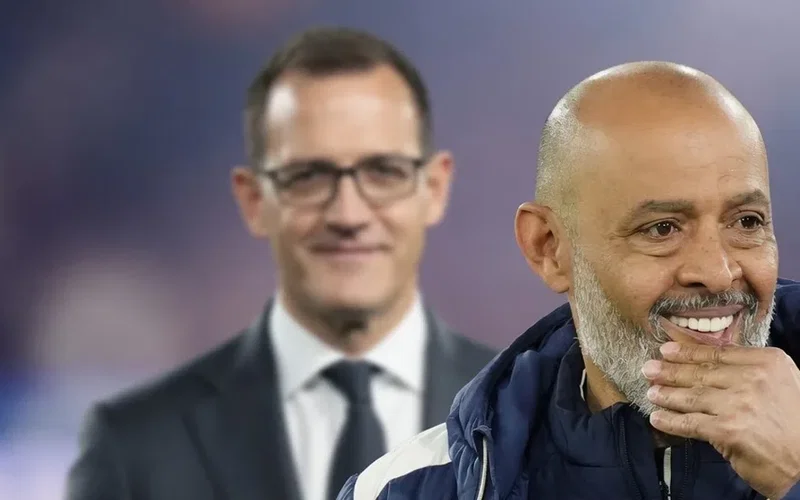
West Ham’s shift toward appointing a Director of Recruitment, with Nils Koppen set to be announced imminently, marks a decisive change in how the club intends to operate. Daniel Kretinsky has made it clear to Nuno Espírito Santo that this is the long‑term direction, and while the title differs from a traditional Director of Football, the implications for Nuno are largely the same.
The structure introduces another footballing voice, one that prioritises long‑term squad building over short‑term control.
Koppen: Working to a different agenda
Nuno’s managerial identity has largely been built on control. His football is system‑driven, his recruitment is profile‑specific, and his authority comes from a tight, loyal group of players who understand exactly what he wants. He has often been described as favouring specialists over generalists and squads of 18–20 players he trusts implicitly. However, Nils is tasked with building depth, succession planning, and protecting resale value.
Even without overseeing the entire football department, Nils Koppen’s remit will be to shape who arrives and why, and that naturally encroaches on Nuno’s domain.
This isn’t a new dynamic for him. At Wolves, Nuno worked within a sporting‑director model under Kevin Thelwell and Scott Sellars, but the Wolves ownership and Jorge Mendes’ influence meant he still held significant sway. Recruitment remained tailored to his system, the squad stayed small, and only when Sellars pushed for broader planning did friction emerge.
At Tottenham Fabio Paratici drove recruitment, and pushed for Nuno to arrive. Yet, Paratici wanted aggressive turnover; Nuno wanted stability. The Portuguese managers, tactical tweaks were met with boos by the club’s supporters and he left after only 124 days. At Nottingham Forest, the sheer size of the squad made his preferred environment impossible. He hinted publicly at the difficulty of managing such volume, and unity, the foundation of his leadership became harder to maintain. It was well documented that he and Edu had major disagreements around transfer targets.
Nuno’s managerial strength has arguably been about trust, with his first team squad, but once trust breaks, players rarely return to favour. James Ward‑Prowse is a recent example of how quickly that relationship can fracture.
The biggest challenge, however, is the Championship itself, with a fixture list of 46 games, domestic cups, and potential play‑offs. Many teams play 60+ matches in a season. Fatigue, injuries, suspensions, and fixture congestion are inevitable. A small squad, Nuno’s ideal simply cannot absorb that load. Rotation becomes essential, training intensity inevitably drops when players are exhausted, and without depth, Nuno will struggle to change games from the bench. Opponents adapt, and his system demands repetition that tired players cannot sustain.
This is why West Ham’s structural shift matters. Nils appointment is designed to modernise the club, create long‑term stability, and prevent short‑term managerial preferences from dictating squad building. For Nuno, it means adapting to a model that expands squad size, spreads decision‑making, and prioritises future planning over immediate cohesion.
The question now is whether he can operate effectively within a structure that doesn’t bend entirely around his methods- because for the first time in years – it won’t.
Look at the bigger picture …If Nuno cant handle it he can go….The club employs him to do what the club wants…The future is evolving ..Get on board or leave…BRAVE NEW WORLD ORDER.
Thanks ai
don’t be silly.
Thanks Ai
don’t be silly.
One problem at club level, that I foresee with a DOR is if they take the route of Paratici at Spurs with ‘aggressive turnover’.
This focuses on selling players at their prime and in theory WHU will no longer have a Brooking, Billy Bonds, Noble playing at WHU for as long as they did. If DIR driven by accounting +/- they’ll want this turnover, while a player such as Brooking or Rice are great players at 31 years of age, which would not happen under a DOR. His remit will be to sell them & get in youngsters, hoping they will be half as good as those who have just departed.
Long story short (for once) hope there is a compromise somewhere that some exceptional players stay and are not sold to balance the books.
Also wonder where the academy fits into a DIR’s remit because it definitely needs to, as it is part of the whole of recruitment. Also, our academy players seem to be failing at the last hurdle, out on loan or in the 1st team. Still hopeful of course, but there is seemingly something missing in WHU academy to 1st team setup.