


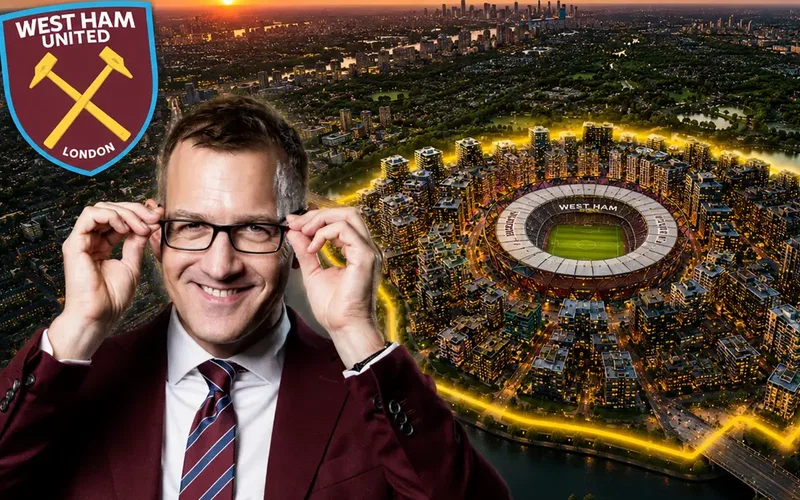
The GLA has commissioned architects to draw up a major new masterplan for Stadium Island, exploring how the land surrounding West Ham’s London Stadium could be developed.
The proposals could eventually see hotels, hospitality, restaurants, leisure facilities and even a second venue built around the stadium as the authorities look to make far more money from the site. At first glance, that probably sounds like a perfectly sensible thing to do with incredibly valuable land in Stratford.
But from a West Ham perspective, I think this could drastically change the landscape around anybody wishing to purchase the club. In many respects, it could actually become a nightmare scenario for the Hammers.
The land could be the real prize
The crucial caveat here is that nobody has publicly guaranteed that the surrounding land would accompany any future sale of London Stadium.
However, part of the allure and attraction of buying West Ham for many potential investors has been the possibility that if you get the stadium, you get the land surrounding it.
That would potentially enable a new owner to knock down the London Stadium, build a purpose-built 60,000-seater football ground on a much smaller footprint and use the surrounding area for hugely valuable development opportunities.
That’s an entirely different proposition from simply buying an expensive, loss-making athletics stadium.
And that’s why the GLA’s decision to appoint Populous to explore a mixed-use development of Stadium Island is potentially so significant for West Ham.

Staveley and The Reuben brothers interest in West Ham centered around the real estate
GLA could take the opportunity for itself
My own concern is that the GLA now appears determined to capture that development value itself.
If hotels, hospitality, restaurants, leisure facilities and a second venue are built around Stadium Island, a future West Ham owner could eventually be left with the football club and perhaps the stadium, but without much of the profitable surrounding land needed to justify completely rebuilding it.
A wealthy buyer might tolerate the enormous cost of demolishing or radically reconstructing London Stadium if the freed-up land could subsequently be developed.
Once the GLA has committed that land to its own masterplan and external partners, much of the potential reward disappears.
And that could severely reduce the incentive for anybody looking at West Ham as a viable profit-making project.
It changes the Staveley equation
This becomes even more interesting when viewed against the backdrop of Amanda Staveley’s continued interest in West Ham.
Staveley has previously spoken about wanting a significant property element attached to her next football investment, which is one reason her interest in West Ham and the London Stadium has always made sense.
Then there are the Reuben brothers, who worked alongside Staveley at Newcastle United and have enormous experience in property development.
As Claret & Hugh reported recently, the Reubens also have significant historical connections to development in Stratford.
Again, none of that means the Reubens are definitely financing a West Ham takeover, nor does it mean any future buyer was guaranteed to receive the surrounding land.
But it does demonstrate why West Ham, the London Stadium and the wider Stratford site could represent something much bigger to a major investor than simply purchasing a football club.
A nightmare scenario for West Ham
The GLA’s desire to make more money from Stadium Island is completely understandable.
The London Stadium continues to be enormously expensive, with Claret & Hugh previously reporting a £68.43m group loss from its most recently published accounts.
But if the GLA develops the surrounding land itself, I think it makes a West Ham purchase far less attractive.
We then become just a football club rather than a football club attached to a potentially enormous property and regeneration opportunity.
Of course, these are exploratory proposals. We don’t know what will eventually be built, whether the London Stadium will ever be sold or what land might be included in any hypothetical deal.
So I’m not suggesting this kills any future West Ham takeover but it does make owning the club far less attractive.
It could drastically reduce the incentive for precisely the type of ambitious, wealthy investor capable of buying West Ham, acquiring the London Stadium and finally turning our home into a proper football ground.
The GLA would likely need a private investor to partner this bold scheme. Maybe Staveley is by passing West Ham for her property grab. When Lord Khan reached out to West Ham saying any reasonable offer for the stadium would be considered, many of us thought it best to sit tight on our cheap rent and wait for an even more advantageous time. However, I did add the caveat that if the GLA looked elsewhere for a buyer we could have an issue if their plans for the stadium, do not align with our own.
Sounds like a clever play to me to get kretinsky or stavely to make a good offer for it all rather than trying to take it on the cheap
There is no need to demolish the stadium. The iconic footprint of the stadium could be preserved and within its confines a new ground constructed with steeper gradients and seats much closer to the pitch. That would in turn expand the concourse areas for the benefit of spectators.
@Dutchman. What you are suggesting is really the same as demolishing the stadium. The iconic footprint is just another name for the foundations. The rest of what you are saying is virtually the same as rebuilding the stadium. I can’t see it as any better or easier than knocking it all down and starting again. You can’t make a silk purse out of a sow’s ear!