



Reports suggesting London Stadium could be purchased by West Ham for £50m have now been publicly dismissed, with the stadium’s owners insisting that no asking price has been established and no offer has ever been received.
The figure appears to have begun as an estimate that the former Olympic venue might be available for around £50m. It was subsequently repeated as though City Hall had placed an official valuation on the stadium, which is simply not the case.
A London Stadium spokesperson has now told City AM: “There has never been an offer to purchase London Stadium, and no price has been set.” However, even at the supposedly cheap price of £50m, purchasing the ground would be a futile exercise unless the buyer had significant additional funds to redevelop it.
£50m West Ham Price Would Only Be The Beginning
In many respects, £50m would merely represent an entry fee. Whoever purchased London Stadium would probably need to pour more than ten times that amount into reconfiguring the former Olympic arena if the ambition was to transform it into a proper football ground.
It is worth remembering what the stadium was originally designed to become. The initial Olympic legacy plan was for the top two tiers to be dismantled after the 2012 Games, leaving a 25,000-seat athletics venue with partial roof coverage.
The lower tier was constructed as the permanent element, while approximately 55,000 seats above it were designed to be demountable. The original roof was subsequently removed and replaced with a new structure twice its size during the expensive conversion that followed West Ham’s appointment as anchor tenant.
Therefore, much of what supporters now regard as a permanent 60,000-plus capacity football stadium was never originally conceived in that form. The distance from the pitch, the divided tiers and the difficulties in creating an intimidating football atmosphere are all consequences of adapting an athletics venue for a purpose it was never designed to fulfil.
West Ham have previously attempted to improve the configuration by moving sections of the lower tier closer to the pitch. However, shifting a few seats forward cannot resolve the fundamental structural problems created by the running track and enormous gap between the two tiers.
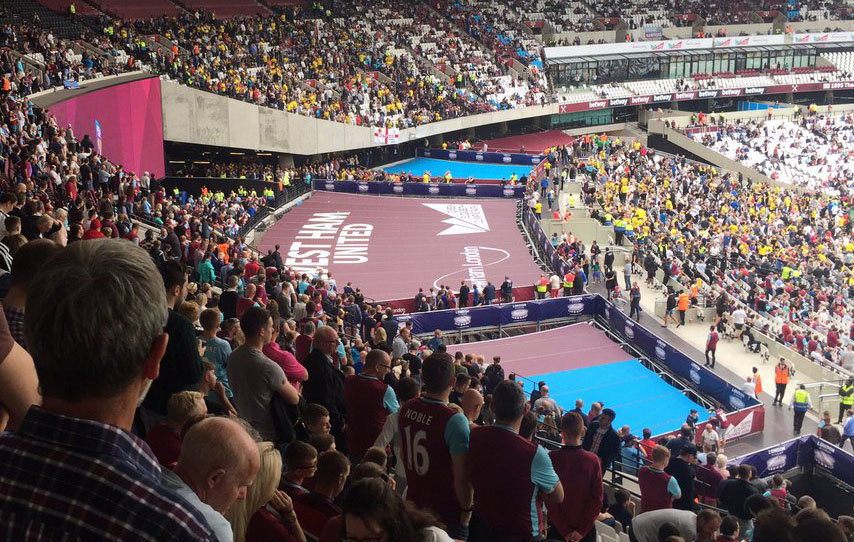
Reconfiguration needed. London Stadium has large fabric sheets to cover the gaps between tiers
West Ham Would Inherit An Enormous Liability
Last weekend’s torrential rain during the Southampton game brought numerous complaints from supporters about shelter, leaks and water entering parts of the stadium. It served as another reminder that purchasing the ground would mean inheriting its maintenance problems as well as its commercial possibilities.
That said, the Greater London Authority will eventually have to confront the financial reality. The venue is reportedly costing taxpayers approximately £19m annually, and West Ham sources have previously described the stadium as a substantial liability requiring heavy capital expenditure.
The stadium’s accounts have consistently demonstrated why West Ham have been reluctant to purchase it. Previous figures examined by Claret & Hugh revealed considerable operating losses, significant debts and enormous provisions for future losses arising from the existing agreements with West Ham and UK Athletics.
No amount of tinkering around the edges with additional concerts, baseball games, boxing events or naming rights appears likely to transform a loss approaching £20m into a sustainable profit.
London Authorities May Have To Cut Their Losses
At some stage, the Greater London Authority may have to accept that the present arrangement is financially unsustainable and cut its losses. West Ham could then have an opportunity to acquire the stadium, but ownership would only make sense if it came with the freedom and financial backing required to rebuild it properly.
The club already have the protection of a 99-year agreement and pay a comparatively small annual rent, which was reduced further following relegation. From a purely financial perspective, remaining as tenants currently makes considerably more sense than assuming responsibility for the losses, maintenance and redevelopment costs.
Buying London Stadium for £50m might sound like a bargain. In reality, that would probably be the cheapest part of the entire project.