


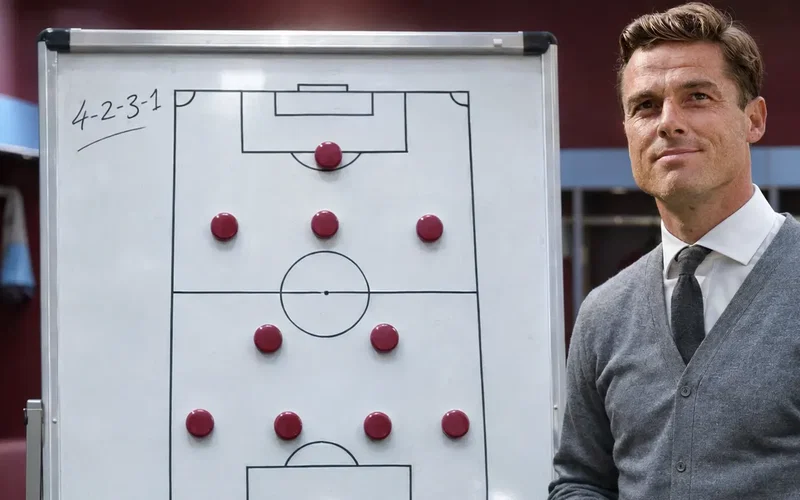
With Scott Parker set to become West Ham United’s new head coach, I’ve been looking back at his three Championship promotion campaigns to get a better idea of what supporters can expect. Rather than simply guessing how he’ll set up the Hammers, I wanted to examine the formations and players he actually used at Burnley, Bournemouth and Fulham.
And having looked through the evidence, I’m increasingly convinced that Parker will favour a 4-2-3-1 at West Ham. It was his preferred system during Burnley’s remarkable 2024/25 promotion campaign, and he also used it at both Bournemouth and Fulham, although he was prepared to switch formations when necessary.
As discussed earlier today, his record of securing promotion with three different clubs was always likely to appeal to West Ham’s decision-makers. But it’s the way he achieved those promotions that interests me, particularly given the problems we’ve witnessed under Nuno Espírito Santo.
Scott Parker’s Three Promotions Reveal A Pattern
Parker’s record is impressive enough without dressing it up. He took Fulham up through the play-offs in 2020, secured automatic promotion with Bournemouth in 2022 and then guided Burnley back to the Premier League with 100 points in 2025.
What I found particularly interesting was that all three sides used a 4-2-3-1 in their final promotion-season matches. That doesn’t mean Parker played the formation every week, but it does provide a useful starting point when trying to establish his tactical preferences.
| Promotion season | Final XI | Conceded |
|---|---|---|
| Fulham 2019/20 | 4-2-3-1 | 48 |
| Bournemouth 2021/22 | 4-2-3-1 | 39 |
| Burnley 2024/25 | 4-2-3-1 | 16 |
Those figures show the goals conceded across each 46-match league campaign, rather than just the final matches. And the progression is interesting, with Parker’s most recent promotion-winning team producing by far his strongest defensive record.
However, there’s an important distinction between his Bournemouth and Burnley sides. According to the Premier League’s tactical analysis, Bournemouth actually used 4-3-3 on 27 occasions during their promotion campaign, compared with 13 starts in 4-2-3-1. Parker increasingly favoured the latter towards the end of the season.
Burnley, on the other hand, were much more closely associated with 4-2-3-1. The Premier League’s examination of their promotion campaign identified it as Parker’s first-choice formation, with two midfielders providing defensive protection and the number ten contributing heavily to the press.
How Parker Set Up His Promotion-Winning Teams
To give you lovely C&H readers a clearer picture, I’ve taken the starting elevens from Fulham’s 2020 play-off final victory against Brentford and Burnley’s final Championship fixture against Millwall in 2025.
Both were recorded as 4-2-3-1, although the responsibilities of individual players were not identical.
Fulham 2-1 Brentford — 4 August 2020
| Players | Position |
|---|---|
| Rodák | GK |
| Odoi, Hector, Ream, Bryan | Back four |
| Reed, Cairney | Midfield two |
| De Cordova-Reid, Onomah, Kebano | Attacking three |
| Kamara | Striker |
Burnley 3-1 Millwall — 3 May 2025
| Players | Position |
|---|---|
| Trafford | GK |
| Roberts, Egan-Riley, Estève, Pires | Back four |
| Cullen, Brownhill | Midfield two |
| Edwards, Hannibal, Anthony | Attacking three |
| Barnes | Striker |
The obvious similarity is the presence of two central midfielders behind three more advanced players. That’s the aspect of the formation I find particularly appealing for West Ham.
West Ham Need Parker’s Defensive Organisation
I’ve already seen plenty of people complaining about Parker’s supposedly negative football, but I find that criticism slightly strange when you look at what he achieved at Burnley.
Sixteen goals conceded in 46 Championship games is incredible. Make no mistake about it. His team also recorded 30 clean sheets, a remarkable achievement which helped Burnley finish the season with 100 points.
Burnley scored 69 goals that season, compared with Leeds United’s 95. So there is a legitimate discussion to be had about whether Parker’s football can sometimes be too cautious, but I certainly wouldn’t dismiss the defensive record as a negative.
In fact, I would expect the first priority of any manager arriving at West Ham to be fixing the defence. It’s crap.
There’s a certain irony here, of course. West Ham had the most porous defence in the Premier League when Nuno Espírito Santo arrived last season, and we all remember how Graham Potter’s team seemingly couldn’t defend a corner. Improving that situation was supposed to be one of Nuno’s principal jobs.
Yet in the end, we were left with a pragmatic defensive manager who had seemingly forgotten how to park the bus.
As Nuno’s dismissal following the defeat against West Bromwich Albion demonstrated, the club eventually ran out of patience with performances that were neither defensively convincing nor particularly effective going forward.
I think Parker’s defensive organisation is precisely what West Ham should be looking for now. And if that improved structure can give our more creative players a little extra freedom, then so much the better.
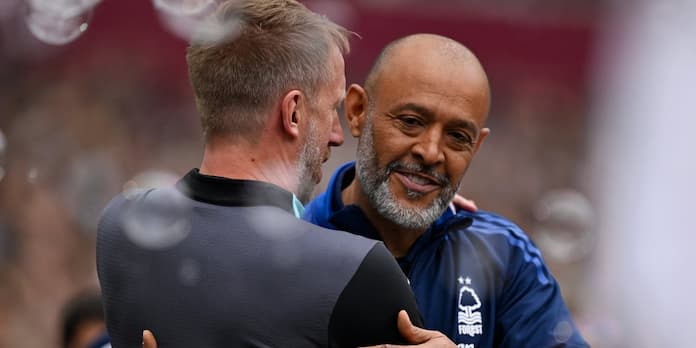
Nuno was brought in to fix Potters awful defence
Why I Expect A 4-2-3-1 At West Ham
Looking at Parker’s previous teams, I believe 4-2-3-1 would be a sensible fit for the players he is inheriting at West Ham. The formation provides two central midfielders who can protect the defence, which should immediately help address the problems we’ve had with opponents dominating the middle of the pitch.
But the benefit isn’t purely defensive. Having that protection behind the attacking players should allow them to operate with considerably more freedom, rather than constantly worrying about what happens when possession is lost.
It also provides something I believe West Ham have desperately needed: a proper number ten.
And I don’t mean somebody like Mohamedou Kanté being shoehorned into a false-nine position he’s not equipped for. I mean a genuine playmaker with an eye for a pass, a stepover and a trick, somebody capable of unlocking a defence rather than simply occupying a position on the pitch.
That’s where Divine Mukasa comes into it for me, although I could also see Manor Solomon operating in that role.
I think either could benefit from having two midfielders behind them, particularly if Jarrod Bowen is given the freedom to get into more dangerous attacking positions.
Of course, there’s an important qualification here. Parker’s Burnley number ten was often expected to work extremely hard without the ball, pressing opponents and helping protect the midfield. So it would be wrong to assume he will automatically select a traditional playmaker simply because he uses 4-2-3-1.
Nevertheless, the formation offers that possibility, and I think it’s one West Ham’s attacking players would hopefully enjoy playing in.
Parker’s Bournemouth Side Wasn’t Just Defensive
There’s another reason I’m reluctant to accept the suggestion that Parker can only produce negative football.
His Bournemouth team were particularly effective at pressing opponents during their promotion season. The Premier League’s tactical analysis recorded them as the Championship’s most intense pressing side by passes per defensive action, with opponents averaging just 10.8 passes before Bournemouth intervened defensively.
That suggests a manager who is capable of setting up a team to win the ball back aggressively, rather than simply sitting deep and hoping to nick a goal.
Bournemouth also conceded only 39 league goals during that campaign, demonstrating that Parker was able to combine a relatively aggressive approach without sacrificing defensive organisation.
And that’s really what I’d like to see at West Ham.
I’m not expecting Parker to turn us into some sort of attacking footballing circus, nor do I think fans should judge him on whether every game produces three or four goals.
But I do expect a team that knows its jobs, defends properly, competes from the first whistle and provides enough attacking support for its better players to make a difference.
The evidence from his previous promotion campaigns suggests Parker is capable of delivering that sort of structure. Whether he can reproduce it at West Ham remains to be seen, but there are genuine reasons for optimism.
Three promotions with three different clubs, a remarkable defensive record at Burnley and a clear history of using systems that could suit West Ham’s attacking players.
For me, that’s a far more useful way of assessing Scott Parker than simply dismissing him as a negative manager before he’s even started.